

SCAR — Sparse Code Audit Retriever
Collection
Sparse retrieval for smart contract security. Sept 2026: see the Known issue on each card; corrected release with the October preprint. • 5 items • Updated
The first sparse latent retriever for smart contract security auditing — built on SAE-LoRA, a parameter-efficient adaptation of frozen Sparse Autoencoder features that turns reconstruction-oriented latents into retrieval-discriminative ones.


Two problems were found in this release during follow-up work; both are documented in full in the corrected preprint (October 2026).
scar-eval overlaps scar-pairs: 800 of its 838 (query, positive) pairs appear verbatim in the training set and all 838 evaluation positives appear as training positives. Every number reported against scar-eval on this card — the headline table, the figures, the checkpoint comparison — measures memorisation, not retrieval. A rebuilt, disjoint training pool (scar-pairs-clean, 6,202 pairs) and a held-out, time-split test set ship with the corrected preprint.sae/checkpoint_final.pt has one feature able to activate (the trainer's own final metrics record L0 = 0.59, not the L0 = 37 quoted below); the encoder decayed during the last quarter of SAE training, and the retriever kept working because its pipeline never applies the thresholds. The sparse code is produced by the backbone LoRA and the SAE-LoRA adapter, not by a preserved feature dictionary: a random-direction encoder with the same column norms reproduces the accuracy, and no feature keeps its top-activating documents after adaptation. The interpretability framing on this card is withdrawn.What stands: the retrieval pipeline, the checkpoints as artifacts, and the inverted-index efficiency results (23 MB index, 32 ms retrieval on 232k documents in the latest measurement). Corrected numbers, early-stopped checkpoints, a second backbone with a live public dictionary, and released weights follow in October 2026.
SCAR retrieves vulnerable Solidity code from natural-language audit findings. On a 232,107-document corpus it achieves R@10 = 0.901 while BM25 collapses to 0.308 — a 2.9× advantage at full retrieval scale. The technical contribution is SAE-LoRA: a 4.6M-parameter low-rank adaptation of a frozen JumpReLU SAE encoder that improves standalone retrieval 37.6× over the frozen-SAE baseline (R@10: 0.026 → 0.977 on controlled eval).
| Metric | BM25 | SPLADE-Qwen | SCAR-25ep | SCAR-15ep |
|---|---|---|---|---|
| R@10 (838-pair eval) | 0.689 | 0.963 | 0.977 | 0.971 |
| R@10 (full 232k corpus) | 0.308 | 0.838 | 0.901 | 0.868 |
| MRR (full corpus) | 0.282 | 0.716 | 0.803 | 0.771 |
| nDCG@10 (full corpus) | 0.288 | 0.743 | 0.825 | 0.792 |
| EVMBench coverage (OOD) | 0.720 | — | 0.683 | 0.732 |
All gains over BM25 are statistically significant at p < 0.0001 (paired bootstrap, n = 10,000).
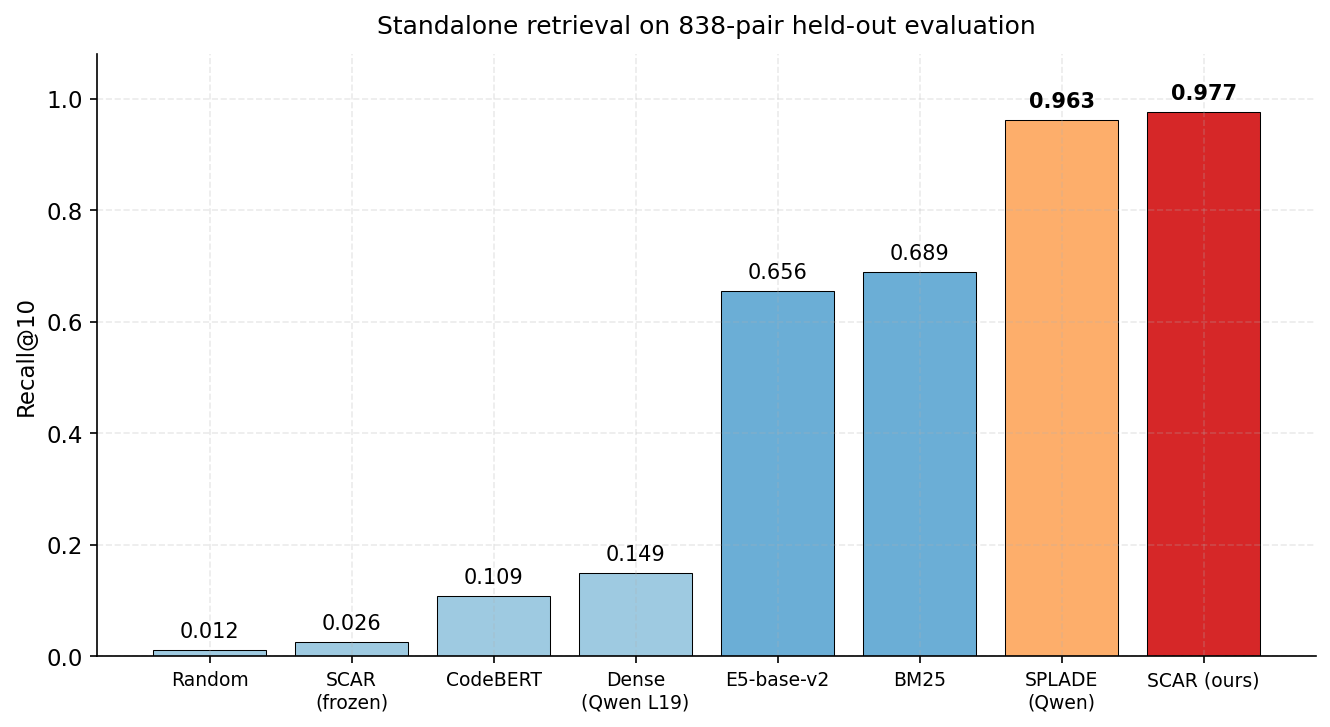
SCAR achieves R@10 = 0.977 on the 838-pair held-out evaluation, surpassing BM25 (0.689) and the next-best learned sparse method (SPLADE-Qwen, 0.963). The frozen-SAE baseline scores 0.026 — barely above random (0.012) — confirming that SAE-LoRA, not the SAE alone, drives retrieval discrimination.
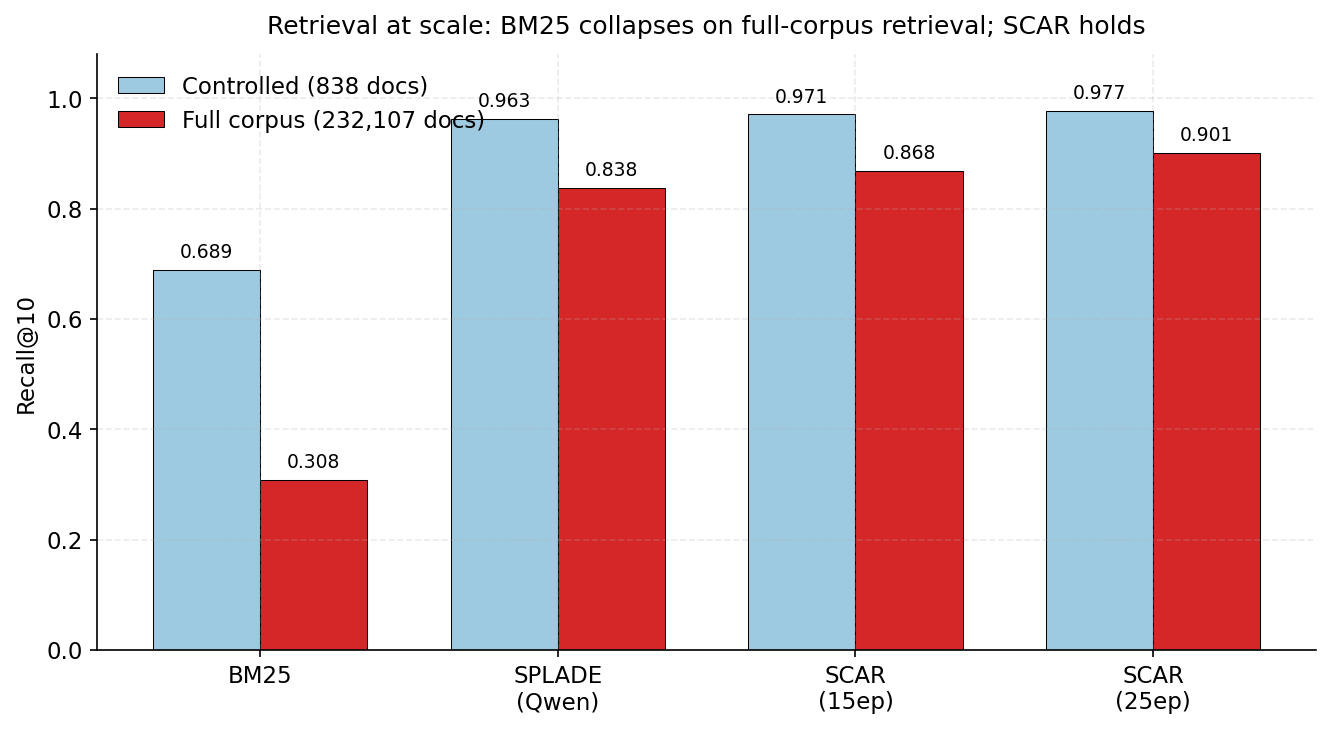
Retrieval at scale: when the corpus expands from 838 to 232,107 documents (a 277× increase), BM25 collapses (0.689 → 0.308) but SCAR's sparse semantic features remain robust (0.977 → 0.901). The SAE advantage over SPLADE-Qwen widens at full scale.
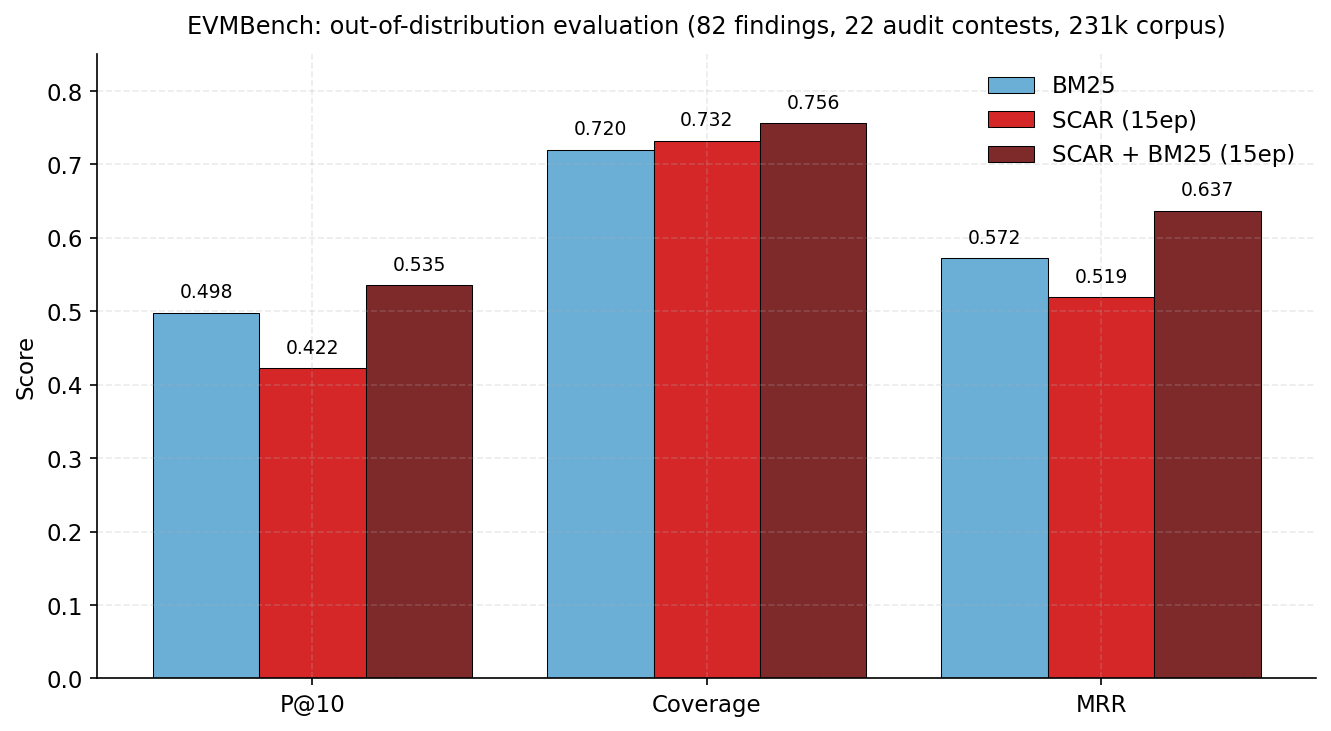
Out-of-distribution evaluation on EVMBench (82 high-severity findings across 22 real audit contests). The 15-epoch SCAR + BM25 hybrid surpasses BM25 on every metric: P@10 = 0.535 (+0.037), Coverage = 0.756 (+0.036), MRR = 0.637 (+0.065).
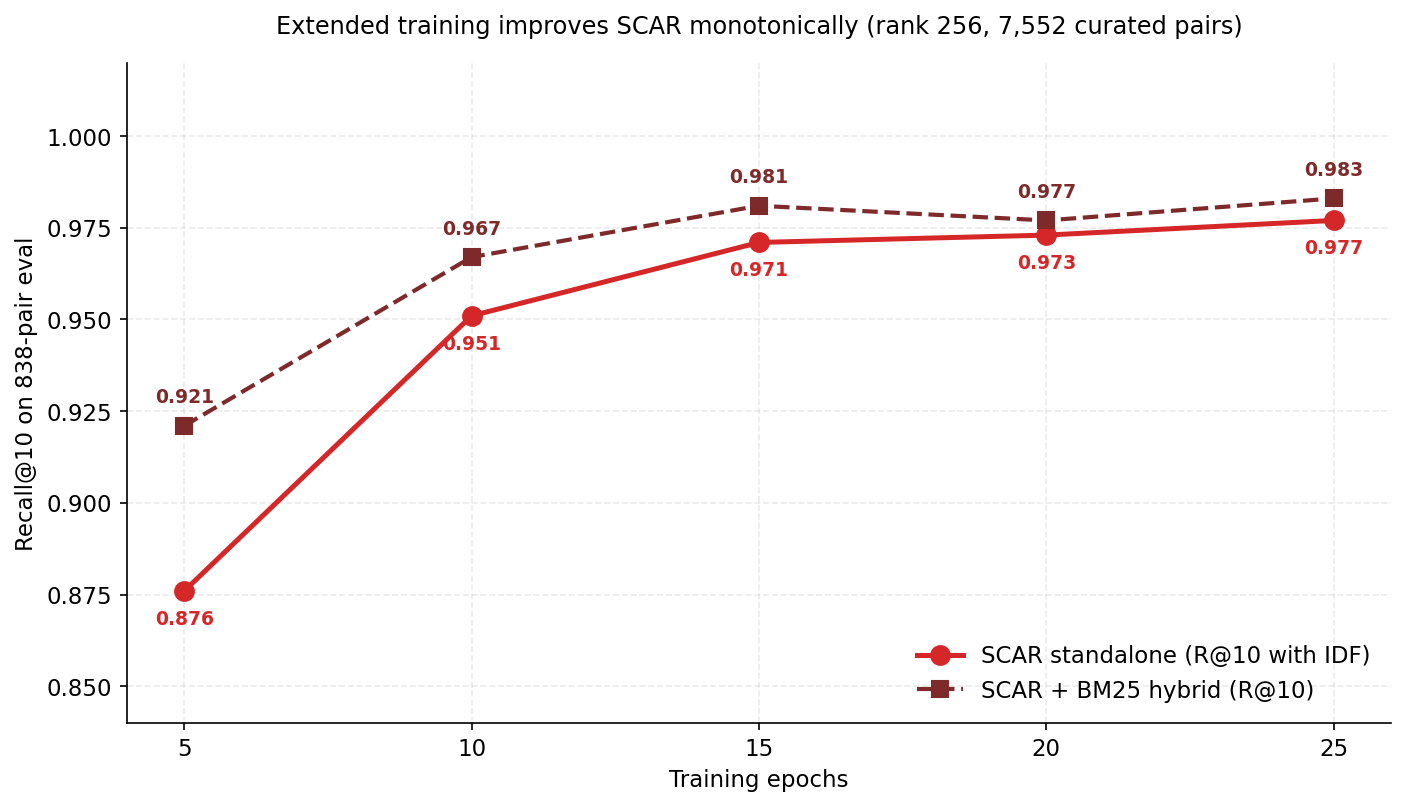
Extended training improves SCAR monotonically with no overfitting on in-distribution data. The 15-epoch checkpoint trades a small in-distribution drop for substantially better OOD coverage on EVMBench.
SCAR ships two adaptations of the same SAE — pick by deployment context.
| Checkpoint | Best for | Standalone R@10 | EVMBench Coverage |
|---|---|---|---|
scar-25ep |
Closed-domain retrieval (auditor KBs, known-corpus precedent search) | 0.977 | 0.683 |
scar-15ep |
Open-domain / OOD retrieval (scanning unseen contracts at deploy time) | 0.971 | 0.732 |
The tradeoff: extended training produces sparser document representations (active features per doc drop 152 → 115), which sharpens precision on the training distribution but reduces coverage of unseen vulnerability patterns. The 15-epoch checkpoint is the right call when you cannot guarantee the corpus matches the training distribution.
Input text
    │
    ▼
Qwen2.5-Coder-1.5B + LoRA (rank 64 on Q/K/V/O)
    │
    ▼ Layer 19 residual stream (1536-dim, bidirectional)
    │
JumpReLU SAE encoder (W_e + A·B  ←  SAE-LoRA, rank 256)
    │
    ▼ 16,384 latent features
    │
Per-token TopK (k=64)  →  Sum-pool  →  log1p saturation
    │
    ▼
IDF weighting  →  Document TopK (q=100, d=400)  →  L2 norm
    │
    ▼
Sparse retrieval vector  (~115 active dims, inverted-index compatible)
| Component | Spec |
|---|---|
| Backbone | Qwen2.5-Coder-1.5B (28 layers, hidden 1536) |
| SAE | JumpReLU, 16,384 features (10.7× expansion), Layer 19 |
| Backbone LoRA | rank 64 on Q/K/V/O — 17.4M params |
| SAE-LoRA | rank 256 on encoder W_e — 4.6M params (~0.3% of backbone) |
| Pooling | Sum-pool + log1p saturation |
| Sparsity | Per-token TopK=64; doc TopK=400; query TopK=100 |
| Active dims after training | ~115 features per document |
| Total trainable | ~22M (1.5% of backbone) |
sae/
├── checkpoint_final.pt   # Frozen JumpReLU SAE (shared by both variants)
└── config.json
scar-25ep/
├── checkpoint_final.pt   # SAE-LoRA state + IDF weights + training config
├── config.json
└── lora_adapter/         # PEFT-compatible backbone LoRA
    ├── adapter_model.safetensors
    └── adapter_config.json
scar-15ep/
├── checkpoint_final.pt
├── config.json
└── lora_adapter/
    ├── adapter_model.safetensors
    └── adapter_config.json
import torch
from huggingface_hub import snapshot_download
from transformers import AutoModelForCausalLM, AutoTokenizer
from peft import PeftModel

# Pull all weights once
local_dir = snapshot_download("Farseen0/scar-weights")
variant = "scar-25ep"   # or "scar-15ep"

# Tokenizer + backbone
tokenizer = AutoTokenizer.from_pretrained("Qwen/Qwen2.5-Coder-1.5B")
backbone = AutoModelForCausalLM.from_pretrained(
    "Qwen/Qwen2.5-Coder-1.5B",
    torch_dtype=torch.bfloat16,
)

# Backbone LoRA via PEFT
model = PeftModel.from_pretrained(
    backbone,
    f"{local_dir}/{variant}/lora_adapter",
)

# SAE-LoRA + IDF + config (everything else is in the .pt checkpoint)
ckpt = torch.load(f"{local_dir}/{variant}/checkpoint_final.pt", map_location="cpu")
sae_lora_state = ckpt["sae_lora_state"]   # A, B matrices for SAE encoder LoRA
idf_weights    = ckpt["idf_weights"]      # (16384,) corpus-derived IDF
config         = ckpt["config"]           # Full training config dict

# Frozen SAE
sae_ckpt = torch.load(f"{local_dir}/sae/checkpoint_final.pt", map_location="cpu")
End-to-end inference (encode → sparse vector → retrieve) is in the GitHub repo; the linked code reproduces all paper numbers.
| Dataset | Purpose | Size |
|---|---|---|
Farseen0/scar-corpus |
SAE pretraining + retrieval corpus | 231,269 contracts |
Farseen0/scar-pairs |
Contrastive training pairs | 7,552 pairs |
Farseen0/scar-eval |
Held-out evaluation | 838 pairs (10 sources) |
Pairs are drawn from professional audit findings (Solodit, MSC, FORGE-Curated, DeFiHackLabs, EVuLLM, SmartBugs-Curated). Each pair: (query = severity-prefixed finding, positive = vulnerable code, hard_negative = different vulnerability from same protocol).
The distillation term provides no measurable benefit at extended training — at 25 epochs Δ = 0.001 R@10 (Table 2 of the paper). The full system improvement comes from SAE-LoRA capacity (rank 256) and extended training.
Measured on the full 232k corpus (H100, batch=1, median of 100 queries):
| Method | Index Size | Encode (ms) | P50 Retrieval (ms) |
|---|---|---|---|
| BM25 | 4,678 MB | — | 5,433 |
| Dense (Qwen L19) | 678 MB | 33.0 | 725 |
| SPLADE (Qwen) | 25 MB | 24.4 | 33 |
| SCAR | 299 MB | 26.2 | 114 |
SCAR is 6× faster than dense retrieval at full corpus scale with a 2.3× smaller index, while delivering substantially higher quality.
@misc{shaikh2026scar,
  title  = {SCAR: Sparse Code Audit Retriever via SAE-LoRA Adaptation},
  author = {Shaikh, Farseen},
  year   = {2026},
  note   = {Preprint; corrected version October 2026},
  url    = {https://github.com/FarseenSh/scar-retrieval}
}
scar-corpus · scar-pairs · scar-pairs-extended · scar-evalApache 2.0 — free for research and commercial use with attribution.
SCAR is independent research by Farseen Shaikh. Built on Qwen2.5-Coder by Alibaba and JumpReLU SAEs by Rajamanoharan et al. (2024).