Instructions to use nxp/Ultralytics-YOLO11-Detection-Ara240 with libraries, inference providers, notebooks, and local apps. Follow these links to get started.
- Libraries
- ultralytics
How to use nxp/Ultralytics-YOLO11-Detection-Ara240 with ultralytics:
from huggingface_hub import hf_hub_download from ultralytics import YOLO # pick the weights file from this repo's "Files and versions" tab weights = hf_hub_download("nxp/Ultralytics-YOLO11-Detection-Ara240", "<weights>.pt") model = YOLO(weights) source = 'http://images.cocodataset.org/val2017/000000039769.jpg' model.predict(source=source, save=True) - Notebooks
- Google Colab
- Kaggle
Overview
Ultralytics released Ultralytics YOLO11 on September 10, 2024, delivering state-of-the-art accuracy and speed. Building on the progress of earlier Ultralytics YOLO versions, YOLO11 introduces improved features and optimizations that make it a strong choice for a wide range of object detection, instance segmentation, classificationand pose estimation tasks across many applications.
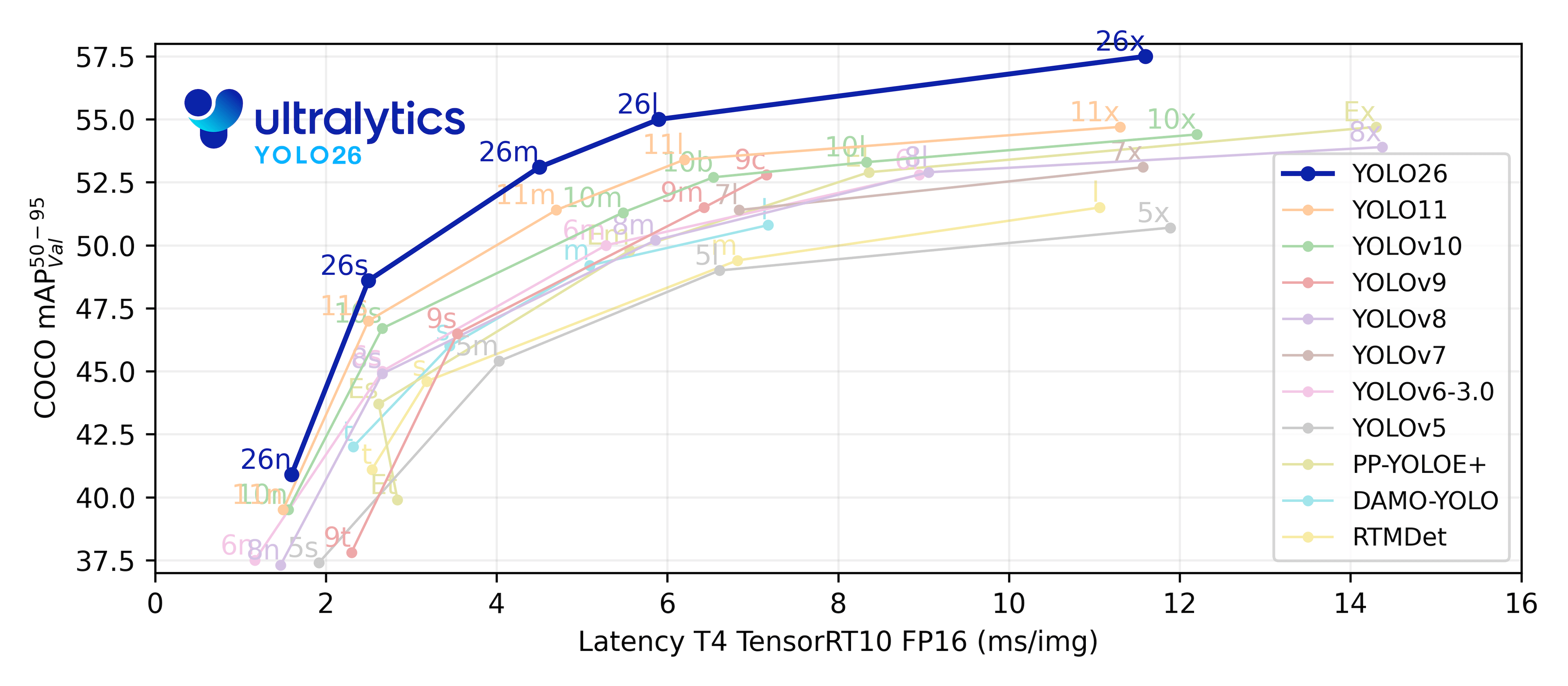
Key Features of Ultralytics YOLO11
- Advanced Backbone and Neck Architectures: YOLO11 enhances the backbone and neck components of previous versions, improving feature extraction and boosting performance across different tasks.
- Efficient Performance Balance: The architecture used across the different YOLO11 models achieves an optimal trade-off between model size and accuracy, enabling short inference times without compromising performance.
- Higher Accuracy with Fewer Parameters: As per YOLO11 architecture, YOLO11m has almost 22% fewer parameters than YOLO8m, while still achieving a higher Mean Average Precision (mAP).
- Multi-Environment Deployment: YOLO11's versatility enables fast deployment in cloud platforms, edge devices, and systems supporting NVIDIA GPUs.
- Multi-Task Capabilities: YOLO11 supports traditional object detection and image classification, as well as pose estimation and oriented bounding box detection (OBB). Note: The models included in this repository are for object detection only.
Model Description
This repository contains Ultralytics YOLO11 pre-compiled models for object detection optimized for NXP Ara240 DNPU.
- Base Model: Ultralytics/YOLO11
- Original Model Authors: Ultralytics
- Original License: AGPL-3.0
Modifications
These pre-compiled models are based on the original Ultralytics YOLO11 models, with below modifications:
- Quantization: INT8, calibrated using COCO val2017
- Compilation: Compiled for the Ara240 DNPU
- Format: Converted to DVM format for NPU deployment
For more information on quantization and compilation procedures, refer to the Ara-Model-Zoo. There you will find the steps and recipes used to compile and quantize the models for Ara240 DNPU deployment.
Getting the Models
This repository uses git tags to version the pre-compiled DVM files by Ara SDK release. Use the Hugging Face CLI to download a specific model for a given SDK release:
# Download a single model for a specific Ara SDK release (e.g., r3.0)
hf download nxp/Ultralytics-YOLO11-Detection-Ara240 yolo11n.dvm --revision r3.0 --local-dir .
# Download all models for a specific release
hf download nxp/Ultralytics-YOLO11-Detection-Ara240 --revision r3.0 --local-dir .
The --local-dir . flag saves the files directly to the current directory instead of the default Hugging Face cache (~/.cache/huggingface/hub).
Replace yolo11n.dvm with yolo11s.dvm, yolo11m.dvm, yolo11l.dvm, or yolo11x.dvm for other model variants.
License
Ultralytics offers two licensing options to accommodate diverse use cases:
- AGPL-3.0 License: This OSI-approved open-source license is ideal for students and enthusiasts, promoting open collaboration and knowledge sharing. See the LICENSE file for more details.
- Enterprise License: Designed for commercial use, this license permits seamless integration of Ultralytics software and AI models into commercial goods and services, bypassing the open-source requirements of AGPL-3.0. If your scenario involves embedding our solutions into a commercial offering, reach out through Ultralytics Licensing.
AGPL-3.0 Source Code Availability
As required by the AGPL-3.0 license, the complete corresponding source code for the software used to produce these pre-compiled models is made available as follows:
- Model source code: All software components and their respective source locations are listed in the SBOM.spdx.json file included in this repository.
- Compilation and quantization recipes: The full steps and scripts used to quantize and compile the models into DVM format are available at Ara-Model-Zoo.
Note: The NXP Ara SDK used to produce the DVM files is a proprietary NXP tool and is not subject to the AGPL-3.0 license. Under AGPL-3.0 Section 1, general-purpose compilation tools used are explicitly excluded from the "Corresponding Source" requirement.
- Downloads last month
- -
Model tree for nxp/Ultralytics-YOLO11-Detection-Ara240
Base model
Ultralytics/YOLO11