


Quantum Assistant
Collection
Multimodal data and models for Quantum Computing with Qiskit
•
12 items
•
Updated







The first multimodal Vision-Language Model specialized for quantum computing with Qiskit
This model is a fine-tuned version of Qwen3-VL-8B-Instruct specialized for quantum computing tasks using Qiskit 2.0. This model can interpret visual representations of quantum computing: circuit diagrams, Bloch spheres, and measurement histograms.
The model was trained using DoRA (Weight-Decomposed Low-Rank Adaptation) with rank 16 for 1 epoch on the Quantum Assistant Dataset. DoRA decomposes weights into magnitude and direction components. This model was part of the Phase 1 PEFT comparison experiments and was not evaluated on external benchmarks.
This model was part of the Phase 1 PEFT variant comparison experiments. It was not evaluated on external benchmarks (Qiskit HumanEval, Qiskit HumanEval Hard, or synthetic test set).
| Metric | Value | Step |
|---|---|---|
| Eval Loss | 0.622 | 183 (final) |
| Eval Token Accuracy | 0.818 | 183 (final) |
| Train Loss | 0.605 | 183 (final) |
| Train Token Accuracy | 0.828 | 183 (final) |
| Training Runtime | 2,307 seconds (~38.5 min) | 1 epoch |
DoRA achieved equivalent performance to rsLoRA (Eval Loss 0.622) in Phase 1 experiments:
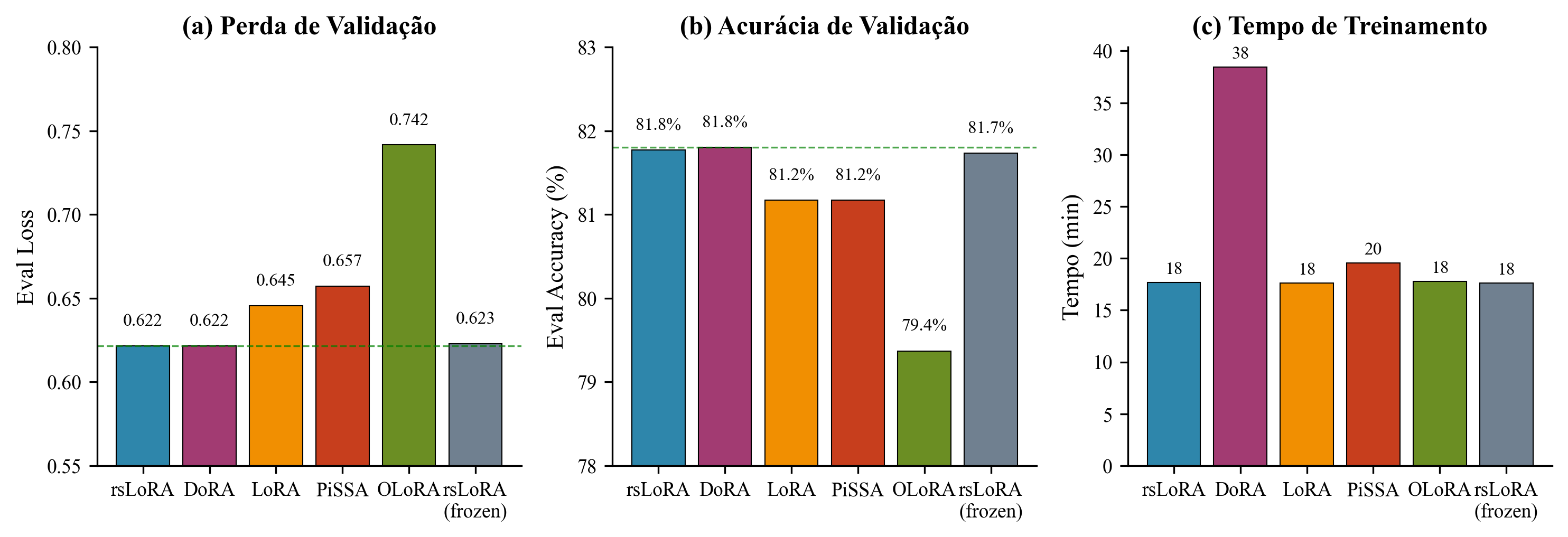
Comparison of PEFT variants: (a) validation loss, (b) token accuracy, (c) training time
Conclusion: While DoRA matches rsLoRA in final performance, the significant computational overhead without performance gains makes rsLoRA the preferred choice for efficiency.
The experimental strategy was organized in two phases: PEFT technique selection and hyperparameter optimization.
Five LoRA variants were compared with controlled configuration (r=16, α=32, 1 epoch):
| Variant | Eval Loss ↓ | Eval Accuracy ↑ | Runtime (s) |
|---|---|---|---|
| rsLoRA | 0.622 | 0.818 | 1,060 |
| DoRA | 0.622 | 0.818 | 2,307 |
| rsLoRA (frozen aligner) | 0.623 | 0.817 | 1,057 |
| LoRA (vanilla) | 0.646 | 0.812 | 1,056 |
| PiSSA | 0.657 | 0.812 | 1,172 |
| OLoRA | 0.742 | 0.794 | 1,067 |
Comparison of PEFT variants: (a) validation loss, (b) token accuracy, (c) training time
Key findings:
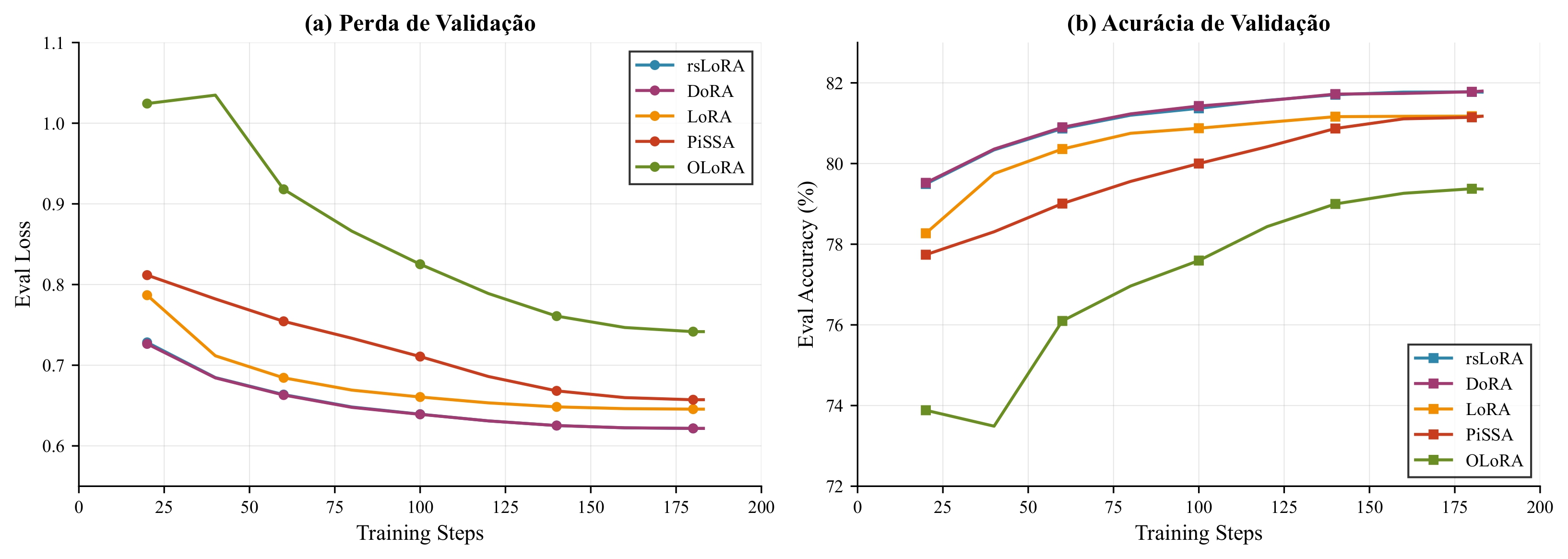
Convergence curves of validation loss for PEFT variants
With rsLoRA selected, the impact of adapter rank and training duration was investigated:
| Configuration | Eval Loss ↓ | Eval Accuracy ↑ | Notes |
|---|---|---|---|
| r=32, 1 epoch | 0.607 | 0.821 | Optimal trade-off |
| r=64, 1 epoch | 0.609 | 0.822 | Marginal improvement |
| r=16, 1 epoch | 0.622 | 0.818 | Baseline rsLoRA |
| r=32, 2 epochs | 0.638 | 0.825 | Slight overfitting |
| r=128, 3 epochs | 0.789 | 0.822 | Severe overfitting |
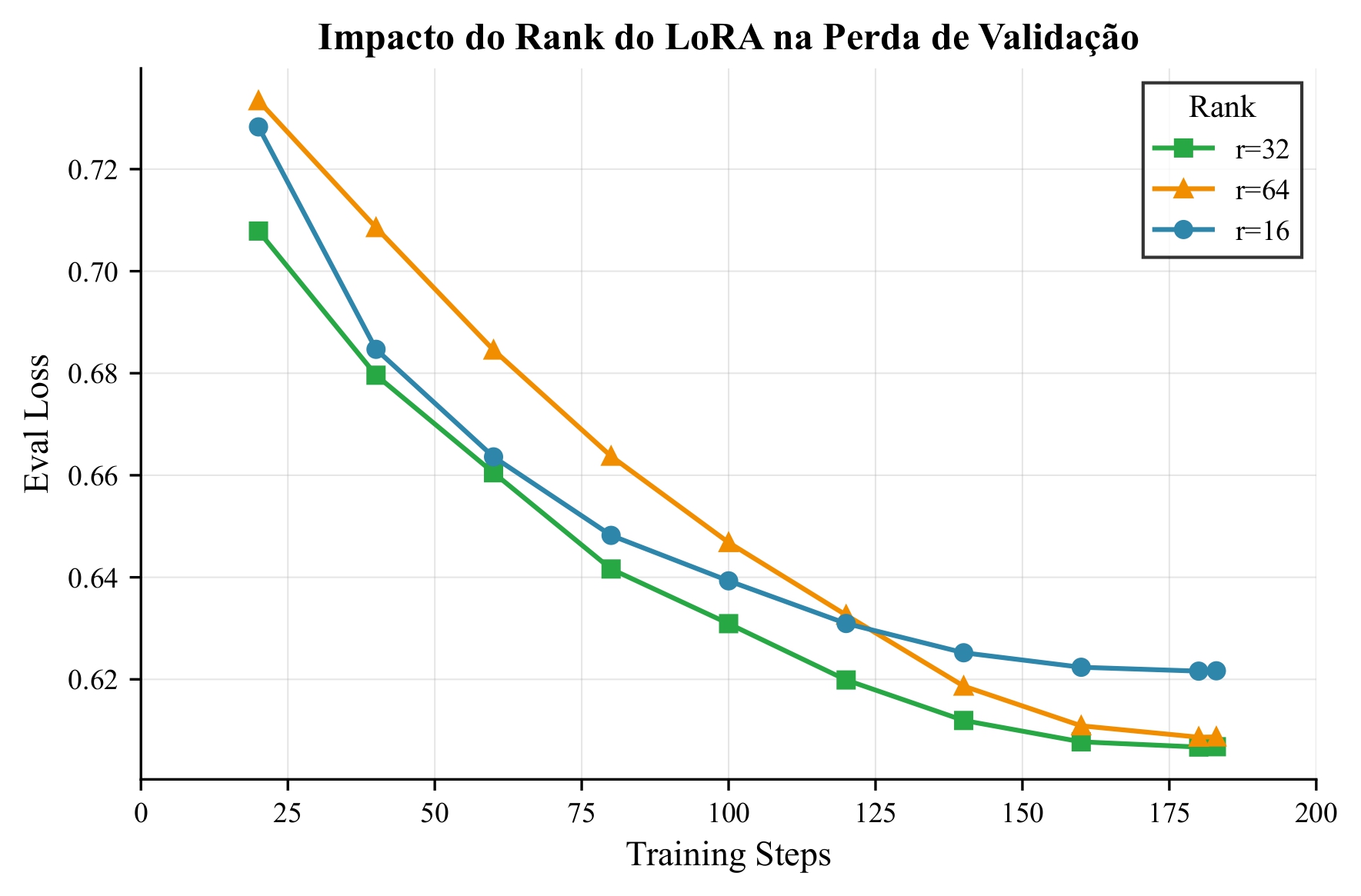
Impact of adapter rank on validation loss
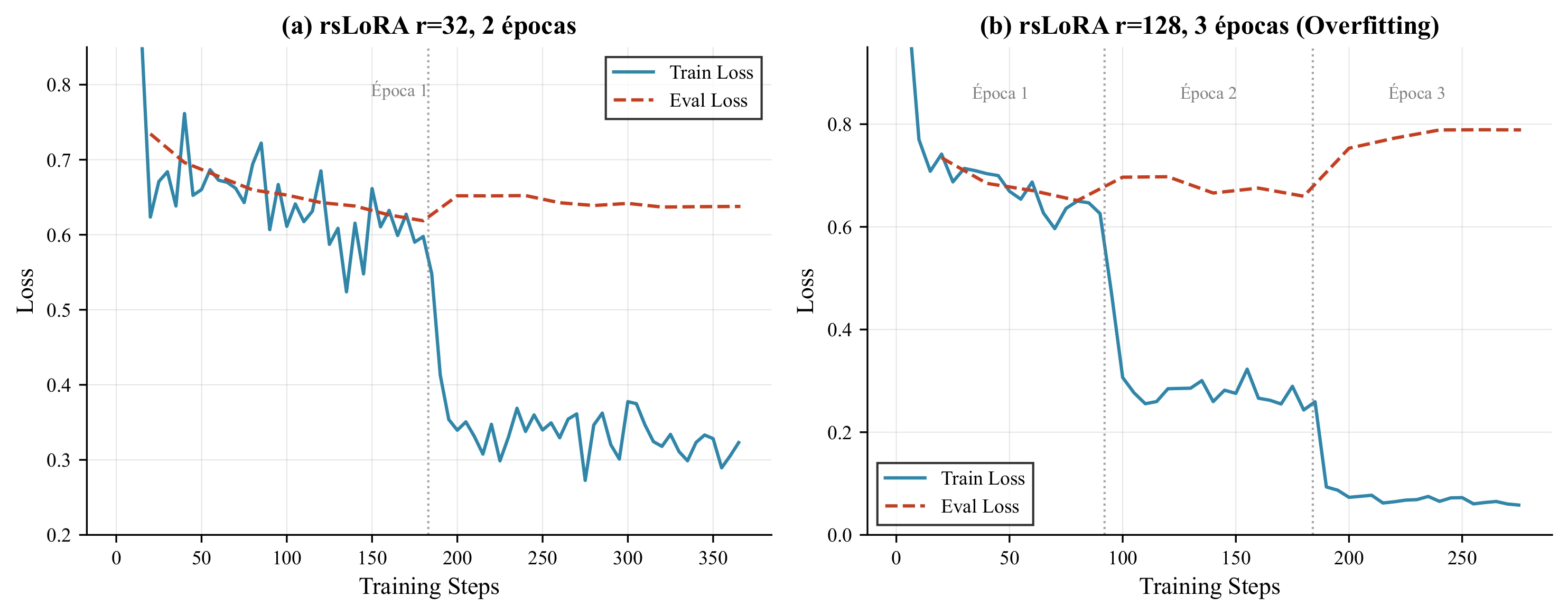
Overfitting analysis: (a) r32-2ep configuration, (b) r128-3ep configuration
Conclusions: rsLoRA with r=32 and 1-2 epochs maximizes generalization while avoiding memorization of the synthetic dataset.
This model is part of the Quantum Assistant collection. All models are merged versions ready for inference:
| Model | Configuration | Description |
|---|---|---|
| Qwen3-VL-8B-rslora-r32-2 | rsLoRA r=32, 2 epochs | Best overall performance |
| Qwen3-VL-8B-rslora-r32 | rsLoRA r=32, 1 epoch | Best generalization |
| Qwen3-VL-8B-rslora-r64 | rsLoRA r=64, 1 epoch | Higher capacity |
| Qwen3-VL-8B-rslora-r128 | rsLoRA r=128, 1 epoch | Maximum capacity |
| Qwen3-VL-8B-lora | LoRA r=16, 1 epoch | Vanilla LoRA |
| Qwen3-VL-8B-dora | DoRA r=16, 1 epoch | Magnitude-direction decomposition |
| Qwen3-VL-8B-pissa | PiSSA r=16, 1 epoch | SVD initialization |
| Qwen3-VL-8B-olora | OLoRA r=16, 1 epoch | QR orthonormal initialization |
| Qwen3-VL-8B-rslora-frozen | rsLoRA r=16, frozen aligner | Ablation study |
| Qwen3-VL-8B-rslora | rsLoRA r=16, 1 epoch | Baseline rsLoRA |
python -m vllm.entrypoints.openai.api_server \
    --host 0.0.0.0 \
    --port 8000 \
    --model samuellimabraz/Qwen3-VL-8B-dora \
    --gpu-memory-utilization 0.92 \
    --max-model-len 12288 \
    --max-num-seqs 16 \
    --max-num-batched-tokens 49152 \
    --enable-chunked-prefill \
    --enable-prefix-caching
from transformers import Qwen3VLForConditionalGeneration, AutoProcessor
from qwen_vl_utils import process_vision_info

model = Qwen3VLForConditionalGeneration.from_pretrained(
    "samuellimabraz/Qwen3-VL-8B-dora",
    torch_dtype="auto",
    device_map="auto"
)
processor = AutoProcessor.from_pretrained("samuellimabraz/Qwen3-VL-8B-dora")

messages = [
    {"role": "system", "content": "You are a quantum computing expert assistant specializing in Qiskit."},
    {"role": "user", "content": "Create a function that builds a 3-qubit GHZ state and returns the circuit."}
]

messages_with_image = [
    {"role": "system", "content": "You are a quantum computing expert assistant specializing in Qiskit."},
    {"role": "user", "content": [
        {"type": "image", "image": "path/to/circuit.png"},
        {"type": "text", "text": "Implement the quantum circuit shown in the image."}
    ]}
]

text = processor.apply_chat_template(messages, tokenize=False, add_generation_prompt=True)
image_inputs, video_inputs = process_vision_info(messages)
inputs = processor(
    text=[text],
    images=image_inputs,
    videos=video_inputs,
    padding=True,
    return_tensors="pt"
).to(model.device)

generated_ids = model.generate(**inputs, max_new_tokens=1024)
output = processor.batch_decode(
    generated_ids[:, inputs.input_ids.shape[1]:],
    skip_special_tokens=True
)[0]
print(output)
| Parameter | Value |
|---|---|
| Base Model | Qwen/Qwen3-VL-8B-Instruct |
| PEFT Method | DoRA (Weight-Decomposed LoRA) |
| Rank (r) | 16 |
| Alpha (α) | 32 |
| Dropout | 0.05 |
| Target Modules | all-linear |
| Learning Rate | 2e-4 |
| LR Scheduler | Cosine |
| Weight Decay | 0.01 |
| Warmup Steps | 10 |
| Epochs | 1 |
| Batch Size | 16 |
| Precision | bfloat16 |
| Framework | ms-swift |
| Component | Status |
|---|---|
| Vision Encoder (ViT) | ❄️ Frozen |
| Vision-Language Aligner | 🔥 Trainable |
| Language Model (LLM) | 🔥 Trainable |
You are a quantum computing expert assistant specializing in Qiskit.
Provide accurate, clear, and well-structured responses about quantum computing concepts,
algorithms, and code implementation. Use Qiskit 2.0 best practices.
circuits_and_gates than primitives_and_executionIf you use this model in your research, please cite:
@misc{braz2025quantumassistant,
  title={Quantum Assistant: Especializa{\c{c}}{\~a}o de Modelos Multimodais para Computa{\c{c}}{\~a}o Qu{\^a}ntica},
  author={Braz, Samuel Lima and Leite, Jo{\~a}o Paulo Reus Rodrigues},
  year={2025},
  institution={Universidade Federal de Itajub{\'a} (UNIFEI)},
  url={https://github.com/samuellimabraz/quantum-assistant}
}
This model is released under the Apache 2.0 License.
Base model
Qwen/Qwen3-VL-8B-Instruct